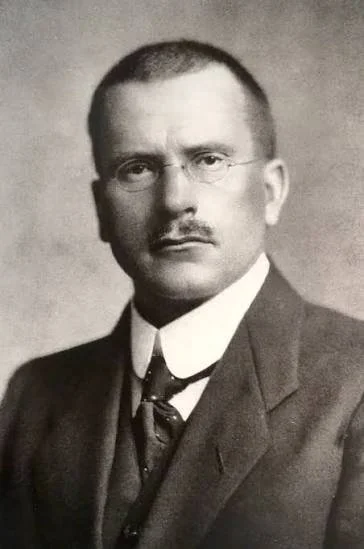
Carl Gustav Jung, photo n.d.
Carl Jung’s dreamwork emerged as both an extension and a rebellion against Freud’s. Where Freud saw dreams as disguised wish‑fulfillment, Jung saw them as communications from the psyche itself — not coded messages to be decoded, but symbolic narratives meant to guide the dreamer toward psychological wholeness. Jung believed dreams were expressions of the unconscious attempting to balance, correct, or expand the conscious mind, a process he called compensation. Unlike Freud, who emphasized childhood conflict and repressed desire, Jung emphasized archetypes, mythic imagery, and the collective unconscious, arguing that dreams draw from universal symbolic patterns shared across cultures and history. His dreamwork landscape was not a map of repression but a mythic terrain, where symbols like the shadow, the anima/animus, the wise old man, and the hero appeared as guides in the dreamer’s individuation journey.
Jung’s method relied heavily on amplification, a technique in which the dreamer explores the broader cultural, mythological, and symbolic meanings of dream images rather than reducing them to personal childhood memories. He encouraged patients to engage with dream symbols through active imagination, art, writing, and dialogue with inner figures. This made Jung’s dreamwork more expansive, creative, and spiritually oriented than Freud’s. Scholars such as Sonu Shamdasani (Jung and the Making of Modern Psychology, 2003), Andrew Samuels (Jung and the Post‑Jungians, 1985), and Marie‑Louise von Franz (Dreams, 1991) emphasize that Jung saw dreams not as puzzles to solve but as living expressions of the psyche’s attempt to evolve. His approach opened the door to modern symbolic, mythopoetic, and therapeutic dreamwork traditions that continue today.
References
Jung, C. G. (1968). Man and His Symbols.
Jung, C. G. (1959). The Archetypes and the Collective Unconscious.
von Franz, M.-L. (1991). Dreams.
Shamdasani, S. (2003). Jung and the Making of Modern Psychology.
Samuels, A. (1985). Jung and the Post‑Jungians.