Why the Planet Is Getting Sicker — And Why It's Everyone's Business
Part 5: Why We Are Getting Sicker
In this series, we have walked through why we as humans — women, men, and children — are getting sicker. We have looked at hormones, toxins, stress, disconnection, and the systems that profit from our illness. But today we need to zoom out. All the way out. Because the body we have been ignoring the longest is not human at all.
It is the planet.
And here is the truth we do not often say out loud: you cannot have a healthy human on a sick planet. These are not separate conversations. They never were. The air we breathe, the water we drink, the food we grow, the frequency waves we bathe in constantly — it all exists on a continuum. What we do to the Earth, we do to ourselves. What we do to ourselves, we do to each other. Everything is connected.
So let us talk about it.
The Patient We Keep Ignoring
The planet does not show up in a doctor's office with symptoms. It does not fill out intake paperwork or get a diagnosis. But if it did — if the Earth could walk in and describe what is happening to it — the list would be long, alarming, and eerily familiar to what we have been hearing from our human patients all along.
Inflammation. Toxic overload. Disrupted communication systems. A breakdown of protective barriers. A crisis of waste it cannot process fast enough.
Sound familiar?
The Invisible Storm: 5G, EMF, and What It's Doing to Our Smallest Creatures
We cannot see it, smell it, or taste it. But it is everywhere now — pulsing through the walls of our homes, saturating our cities 24 hours a day.
Electromagnetic frequency radiation — particularly from 5G infrastructure — has become one of the most hotly debated and least transparently discussed environmental exposures of our time. A growing body of peer-reviewed research tells a complicated story, especially when we look not at humans, but at the insects our food system depends upon.
Thielens et al. (2018) modeled the absorbed radio-frequency electromagnetic power across four insect types in the frequency range of 2 GHz to 120 GHz — precisely the range now occupied by 5G and planned for future generations. Their results showed that as wireless frequencies increase into the millimeter-wave spectrum, insects absorb significantly more electromagnetic energy relative to their body size. The research identified that peak absorption occurs in the insect-sized body range at frequencies now actively used in 5G infrastructure rollout — a finding with direct implications for biodiversity and ecosystem health.
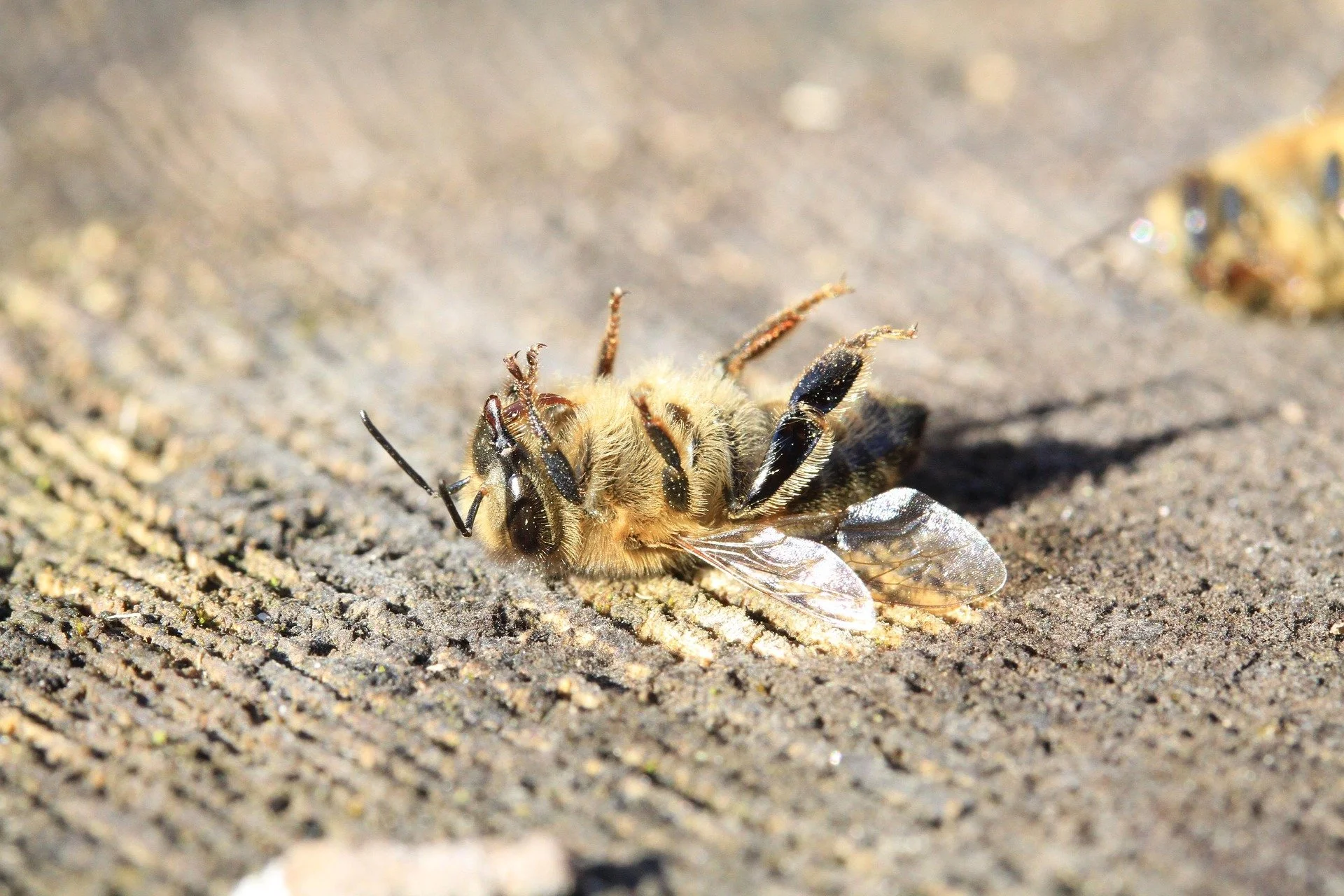
The effects on bees deserve particular attention. Molina-Montenegro et al. (2023) found that electromagnetic fields from high-voltage transmission towers — which generate electromagnetic frequencies comparable to those produced by wireless infrastructure — reduced honeybee floral visitation and pollination dramatically. Researchers observed that bees near high-tension towers visited only a fraction of the flowers they would normally pollinate, with measurable reductions in seed production as a direct result. Since honeybees and other insect pollinators are responsible for pollinating approximately 75% of our global food crops and generating hundreds of billions of dollars in global agricultural value each year (Food and Agriculture Organization of the United Nations [FAO], 2019), any disruption to pollinator behavior is a disruption to the food chain itself.
And we are moving forward with 6G before we have answered the questions 5G raised. Researchers studying next-generation wireless infrastructure note that the ultra-dense deployments and advanced beamforming technologies planned for 6G networks will make electromagnetic exposure assessment and ecosystem-level risk modeling dramatically more complex than anything we have managed before (University of Surrey, 2025). If 5G was deployed without meaningful independent environmental review — and the evidence strongly suggests it was — what does it mean to accelerate into 6G and potentially 7G with the same urgency and the same absence of ecological precaution?
We do not yet have a full answer. That is precisely the problem.
What you can do: Limit unnecessary wireless device exposure at home. Turn your WiFi router off at night. Keep phones out of children's bedrooms. Support organizations calling for independent environmental review before next-generation wireless infrastructure is deployed.
Glyphosate: The Poison We Declared a National Security Priority
On February 18, 2026, President Trump signed an executive order invoking the Defense Production Act to guarantee the domestic supply of glyphosate-based herbicides — the active ingredient in Roundup and the most widely used weedkiller in the world (Environmental Working Group [EWG], 2026).
Let that land for a moment.
The same substance the International Agency for Research on Cancer classified as a "probable human carcinogen" — Group 2A — was just elevated to a matter of national security (International Agency for Research on Cancer [IARC], 2015). The same chemical at the center of billions of dollars in liability settlements was shielded from further scrutiny and fast-tracked for expanded domestic production.
"If anyone still wondered whether 'Make America Healthy Again' was a genuine commitment to protecting public health or a scam," Environmental Working Group President Ken Cook wrote, "today's decision answers that question" (EWG, 2026).
Here is what the science has established about glyphosate in our environment:
Glyphosate has been detected across virtually every environmental compartment — surface water, groundwater, soil, and ambient air — across the United States and Europe. It has entered the human body at scale. Data from the U.S. Centers for Disease Control and Prevention's National Health and Nutrition Examination Survey confirmed glyphosate detection in the urine of the vast majority of Americans tested, including children as young as three (Centers for Disease Control and Prevention [CDC], 2023). What once was an occupational exposure for farmworkers has become a near-universal one.
At the tissue level, research published in Biomolecules documented that chronic glyphosate exposure produces changes in gene expression associated with oxidative stress, cellular apoptosis, and kidney fibrosis — suggesting long-term organ-level damage that does not require high-dose acute exposure to accumulate (Mesnage et al., 2025). Wildlife is equally affected: glyphosate has been found to disrupt the gut microbiome of honeybees, compromise amphibian immune function, and accumulate in the tissue of fish downstream from agricultural applications.
The executive order expands production. Proposed federal legislation would strip states of the right to require warnings beyond what the EPA mandates. The guardrails are being removed.
What you can do: Buy organic when possible, prioritizing the Environmental Working Group's annual "Dirty Dozen" list. Filter drinking water with a reverse osmosis or activated carbon block filter certified to remove herbicides. Avoid glyphosate-based products on your lawn or garden. Support state-level legislation protecting the right to know what is in your food and water.
The Amazon: The Planet's Lungs Are Still Bleeding
The Amazon rainforest produces approximately 20% of the world's oxygen and is home to roughly 10% of all species on Earth. It is not a distant environmental story. It is a life support system for every person reading these words.
Research published in Science Advances identified a potential tipping point at approximately 20–25% deforestation of the Brazilian Amazon — the threshold at which the forest may lose the capacity to sustain its own hydrological cycle and begin an irreversible transition toward savanna (Lovejoy & Nobre, 2018). The Brazilian Amazon is already approaching that boundary. "The tipping point is here, it is now," Lovejoy and Nobre (2019) wrote in a follow-up editorial. "We stand exactly in a moment of destiny."
In 2024, driven by record drought, deliberate fire-setting, and agricultural expansion, total forest disturbance across the Amazon reached 64,686 square kilometers — a 153% increase compared to 2023, and one of the most alarming single-year surges on record (European Commission Joint Research Centre [JRC], 2025). Cattle ranching accounts for the majority of this deforestation, followed closely by soy cultivation destined largely for livestock feed in industrial agriculture supply chains worldwide.
There is cautious good news: Brazil recorded its lowest measured deforestation rate in 11 years during the 2024–2025 monitoring period, attributable to stronger enforcement and satellite monitoring programs (Amazon Regional Observatory, 2025). But the structural pressures — commodity demand, land speculation, and the removal of federal protections — have not been resolved. The recovery is fragile. The window that Lovejoy and Nobre identified is narrowing.
When the lungs of the planet are compromised, every breath we take is affected. This does not stay in the Amazon.
What you can do: Choose products certified as deforestation-free. Reduce beef consumption — even one or two meatless days per week has a measurable impact. Support conservation organizations working directly in the Amazon basin. Pay attention to where your soy, palm oil, and timber products originate.
The End of Protection: What the ESA Rollback Really Means
On July 10, 2026, the Trump administration finalized a rule eliminating one of the most fundamental provisions in the 50-year history of the Endangered Species Act.
For decades, the ESA defined "harm" to a protected species as including significant habitat modification or degradation — the legal logic being that destroying where an animal lives, breeds, or feeds constitutes harm to the animal itself. The Supreme Court upheld this interpretation in 1995. Scientists and conservationists have credited this provision with preventing the extinction of 99% of listed species since the Act's passage in 1973 (Daly, 2026).
The new rule eliminates that protection. Destroying critical habitat is no longer, by itself, a prohibited action under the ESA. Oil drilling, mining, logging, and development may proceed in the habitat of listed endangered species, provided the animals are not directly killed in the moment of the activity (Daly, 2026).
Among the species whose survival depends most immediately on habitat protection: the Florida manatee, the Pygmy rabbit, the Rice's whale in the Gulf of Mexico, and the monarch butterfly — species already living on the margins of viability.
"Habitat loss is the number one cause of extinction," said Gib Brogan of Oceana, as reported by Daly (2026). "When you remove habitat protections, you remove one of the law's most important safeguards."
This is not a political opinion. It is ecology. Biodiversity is not optional. Every species removed from an ecosystem pulls threads from a web that everything — including humans — depends upon.
What you can do: Contact your Congressional representatives to oppose ESA rollbacks. Support organizations like the Center for Biological Diversity and Earthjustice, which are challenging these rules in federal court. Choose brands that commit to zero habitat destruction in their supply chains.
Waste: The Crisis at Our Feet
The United States generates hundreds of millions of tons of municipal solid waste each year. In 2024, the plastics recycling industry recovered over 5.1 billion pounds of post-consumer plastic — a record — yet industry leaders acknowledged that low-cost virgin plastic continues to structurally undercut recycled material in the market, making systemic change difficult to sustain through voluntary market forces alone (Association of Plastic Recyclers, 2025).
In our cities, the waste crisis takes on an immediate and visible form. In Los Angeles, cleanup operations collected over 5,600 tons of solid waste from homeless encampments across an eight-month period — a number that reflects not only a waste management failure, but a compounding failure of housing policy, mental health infrastructure, and addiction treatment systems (City of Los Angeles Bureau of Sanitation, 2021). Studies of urban waterways downstream from encampments have documented dangerous elevations in fecal coliform bacteria and other biological contaminants, with documented impacts on aquatic ecosystems (Ramirez et al., 2022).
It is important to say this directly: the visible waste associated with urban homelessness is a symptom of systemic failure, not a character failing of the individuals experiencing it. Research consistently shows that when cities invest in portable sanitation access, organized waste collection, and harm-reduction infrastructure near encampments, environmental contamination decreases significantly (Ramirez et al., 2022). The waste is not inevitable. The policies that produce it are not inevitable either.
At the landfill level, food waste alone represents one of the most preventable sources of methane emissions — a greenhouse gas more than 80 times more potent than carbon dioxide over a 20-year horizon. When food decomposes in the oxygen-deprived conditions of a landfill rather than composting, it releases methane directly into the atmosphere (U.S. Environmental Protection Agency [EPA], 2024).
What you can do: Refuse single-use plastics. Compost food waste. Buy secondhand. Advocate for sanitation access and housing solutions for unhoused neighbors rather than enforcement-only responses. Support extended producer responsibility legislation that places packaging lifecycle accountability on manufacturers.
The Continuum: Everything Is Connected
Here is what this series has been building toward, blog by blog:
The body cannot be healthy in a sick environment.
When women's hormones are disrupted, we trace it to endocrine-disrupting chemicals in our water, our food containers, our personal care products — the same industrial systems degrading our ecosystems. When children have asthma, we trace it to air quality — affected by the same deforestation, the same emissions, the same burning of fossil fuels that destabilizes our atmosphere. When men's testosterone declines, when bees lose their ability to navigate, when salmon cannot find their spawning grounds — these are not separate stories. They are chapters in the same book.
The planet is not our backdrop. It is our body. We evolved inside it, from it, in a relationship with it spanning hundreds of thousands of years. What we do to rivers, to forests, to the electromagnetic environment, to the soil — we do to ourselves. With a delay, sometimes. But always, eventually, to ourselves.
Our Part: Responsibility, Solutions & Daily Choices
The scale of what this post describes can feel paralyzing. It is not meant to. It is meant to be honest — because you deserve honesty, and because change has always begun with people who were willing to see clearly.
Individual choices matter. Systemic change matters more. We need both.
In your home: Filter your drinking water. Eliminate glyphosate-based products from your yard. Switch to organic cleaning products and fragrance-free personal care. Turn off your WiFi router at night. Compost your food scraps.
In your body: Eat organic when possible, prioritizing the Environmental Working Group's Dirty Dozen list. Reduce beef consumption. Choose whole foods over ultra-processed ones. Spend intentional time in nature.
In your community: Support local organic growers. Advocate for housing and sanitation solutions for unhoused neighbors. Vote in local elections for candidates who prioritize environmental health. Talk about this — without fear, without doom, with evidence and compassion.
In your voice: Contact your representatives about the Endangered Species Act. Support independent research into EMF environmental impacts. Share information — not panic, but truth.
A Note to Close
I started this series asking a simple, urgent question: Why are we getting sicker?
The answer, across five installments, has been the same. Because we have forgotten that we are not separate from the systems we live inside. We are not separate from our hormones, our food, our relationships, our communities, or our planet. Sickness in one creates sickness in all.
But here is what is equally true: healing in one creates the possibility of healing in all.
The planet is resilient. Deforestation rates in the Amazon fell to their lowest in 11 years when enforcement was strengthened (Amazon Regional Observatory, 2025). Species once on the edge of extinction — the bald eagle, the American alligator, the California condor — came back when humans chose to protect them. Rivers that were declared dead have come back to life.
The planet can heal. It needs us to remember that we are part of it — not above it, not free from the consequences of what we allow to happen to it.
Everything is a continuum of everything else.
And so is the solution.
References
Amazon Regional Observatory. (2025). Amazon records a 68% drop in deforestation in 2025. Amazon Cooperation Treaty Organization.
Association of Plastic Recyclers. (2025). 2024 United States national post-consumer plastics recycling report.
Centers for Disease Control and Prevention. (2023). NHANES 2017–2018: Glyphosate (GLYP) — Urine (surplus) data documentation, codebook, and frequencies (SSGLYP_J). National Center for Health Statistics. https://wwwn.cdc.gov/Nchs/Nhanes/2017-2018/SSGLYP_J.htm
City of Los Angeles Bureau of Sanitation. (2021). Homeless encampment cleanup data report. City of Los Angeles.
Daly, M. (2026, July 11). Trump administration rescinds the Endangered Species Act's "harm" rule. Associated Press.
Environmental Working Group. (2026, February 18). Trump's glyphosate executive order: EWG response. https://www.ewg.org
European Commission Joint Research Centre. (2025). Deforestation and forest degradation in the Amazon: Update for 2024 and 2025. Publications Office of the European Union.
Food and Agriculture Organization of the United Nations. (2019). Why bees matter: The importance of bees and other pollinators for food and agriculture. FAO.
International Agency for Research on Cancer. (2015). IARC monographs volume 112: Evaluation of five organophosphate insecticides and herbicides — Glyphosate. World Health Organization.
Lovejoy, T. E., & Nobre, C. (2018). Amazon tipping point. Science Advances, 4(2), eaat2340. https://doi.org/10.1126/sciadv.aat2340
Lovejoy, T. E., & Nobre, C. (2019). Amazon tipping point: Last chance for action. Science Advances, 5(12), eaba2949. https://doi.org/10.1126/sciadv.aba2949
Mesnage, R., Antoniou, M. N., & Séralini, G.-E. (2025). Multi-omics alterations in rat kidneys upon chronic glyphosate exposure. Biomolecules, 15(10). https://doi.org/10.3390/biom15102654
Molina-Montenegro, M. A., Acuña-Rodríguez, I. S., Ballesteros, G. I., Baldelomar, M., Torres-Díaz, C., Broitman, B. R., & Vázquez, D. P. (2023). Electromagnetic fields disrupt the pollination service by honeybees. Science Advances, 9(19), eadh1455. https://doi.org/10.1126/sciadv.adh1455
Ramirez, C., Nguyen, T., & Hoffman, D. (2022). Environmental and public health impacts of urban homeless encampments: A systematic review. Journal of Environmental Health, 84(7), 8–18.
Thielens, A., Bell, D., Mortimore, D. B., Greco, M. K., Martens, L., & Joseph, W. (2018). Exposure of insects to radio-frequency electromagnetic fields from 2 to 120 GHz. Scientific Reports, 8, Article 3924. https://doi.org/10.1038/s41598-018-22271-3
University of Surrey. (2025). Sustainable communications and sensing for future generation wireless cellular networks. Institute for Communication Systems.
U.S. Environmental Protection Agency. (2024). Basic information about landfill gas. Landfill Methane Outreach Program. https://www.epa.gov/lmop/basic-information-about-landfill-gas