How Solar Events Influence Women’s Hormones, Cycles, and the Magnetite‑Driven Biology We Don’t Talk About
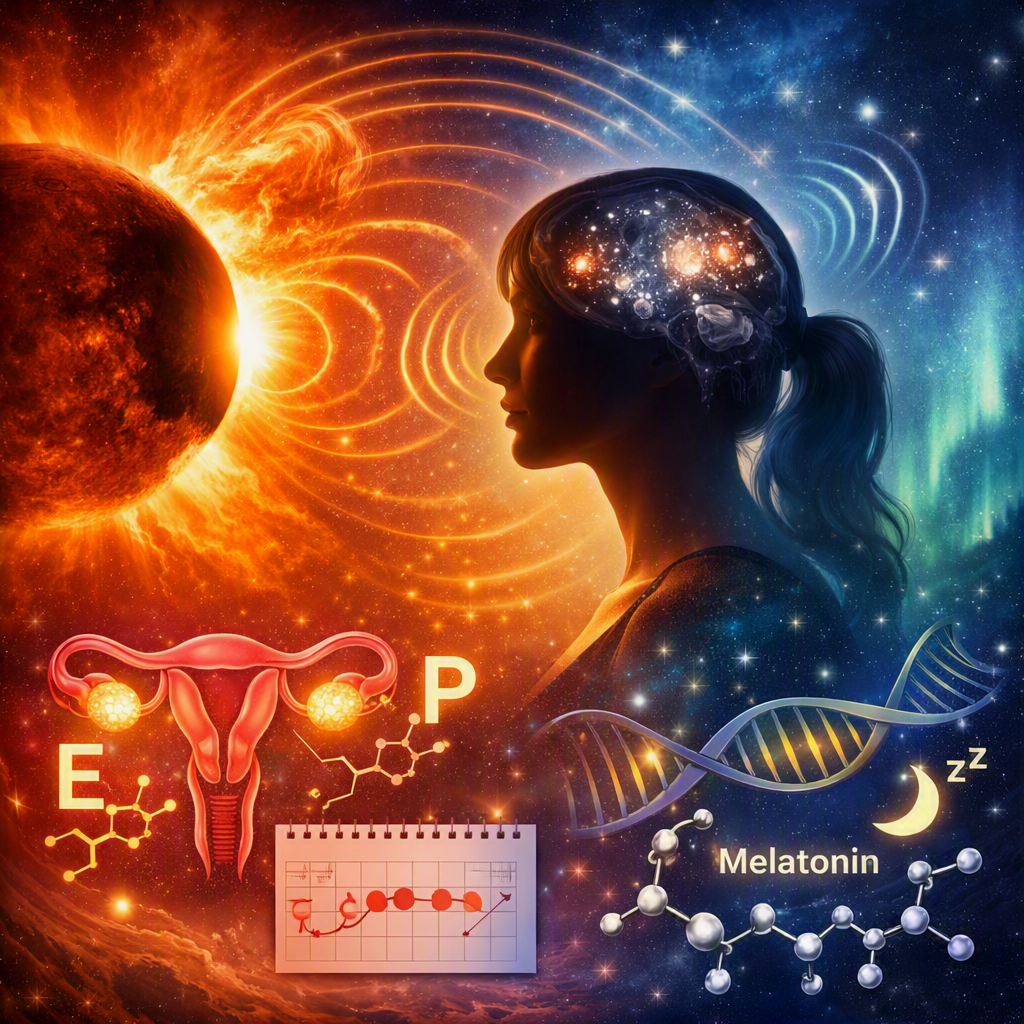
In July, social media exploded with reports from women all over the world saying the same thing: “I didn’t get my period this month.” or “I got two periods.”
This wasn’t a small trend — it was widespread. And it caught my attention because I’ve lived through this pattern myself.
I’m nearing the end of perimenopause. My estrogen last summer was 13. My progesterone has been near zero for years. My cycles have stretched to 3–4 months apart.
But here’s the strange part:
During the last solar eclipse, I started my period after 3 months of nothing — on the day of the eclipse.
This week, with estrogen suddenly at 190, I started my period again — one day before the next major solar event.
Two eclipses. Two long gaps. Two sudden cycles.
And thousands of women reporting the same thing.
So I started researching the connection — not symbolically, not astrologically, but biologically and environmentally. What I found is fascinating and grounded in science.
Solar Events Change the Environment — and Women’s Bodies Respond
A solar eclipse is not just a visual phenomenon. It changes multiple environmental systems at once:
light
temperature
gravity
electromagnetic fields
ionospheric density
circadian rhythm cues
atmospheric pressure
Women’s bodies are ecosystems inside Earth’s ecosystem. When the environment shifts, biology shifts.
Here’s how.
1. Sudden Darkness Alters Melatonin — and Melatonin Alters Reproductive Hormones
Melatonin isn’t just a sleep hormone. It directly interacts with:
estrogen receptors
progesterone receptors
ovarian follicle maturation
hypothalamic hormone release
GnRH pulses
LH/FSH timing
During a solar eclipse:
sudden darkness → melatonin spikes
melatonin spike → cortisol drops
cortisol drop → hypothalamus shifts
hypothalamus shift → cycle timing changes
This is chronobiology.
Melatonin is one of the strongest regulators of menstrual timing.
This alone can cause:
delayed periods
early periods
skipped periods
double periods
sudden bleeding after long gaps
Especially in perimenopause, when the system is already sensitive.
2. Temperature Drops 3–10°C — and Temperature Affects Hormones
During a solar eclipse, ground temperature drops sharply.
Temperature affects:
thyroid activity
cortisol
prolactin
metabolic rate
ovarian hormone release
A sudden temperature drop can shift:
ovulation timing
luteal phase length
menstrual onset
3. Humans Have Magnetite in the Brain — and Magnetite Responds to EM Changes
This is the part most people don’t know.
Humans have magnetite (Fe₃O₄) in the brain — real, measurable, published in Nature, PNAS, and BioMetals.
Magnetite-containing neurons exist in:
the meninges
the hippocampus
the cerebellum
the pineal region
the olfactory bulb
Magnetite responds to:
electromagnetic fields
ionospheric changes
geomagnetic fluctuations
solar radiation shifts
During a solar eclipse:
the ionosphere cools
electron density drops
Earth’s magnetic field compresses slightly
EM propagation changes
Magnetite neurons detect these changes.
And magnetite neurons are located near regions that regulate:
melatonin
cortisol
circadian rhythm
reproductive hormones
This is a real biological pathway connecting solar events to hormonal shifts.
4. EM Field Changes Influence Melatonin and Cortisol
Solar events alter:
radio propagation
ionospheric density
geomagnetic field strength
electromagnetic exposure
Research shows EM changes can:
suppress melatonin
increase melatonin
alter cortisol
shift circadian rhythm
affect sleep
affect mood
affect autonomic nervous system
Melatonin + cortisol = cycle timing.
This is neuroendocrinology.
5. Water, Electrolytes, and Gravity Play a Role
Women are 70% water. Blood is plasma + electrolytes. Electrolytes respond to:
gravity
pressure
temperature
EM fields
During a solar eclipse:
tides shift
atmospheric moisture changes
pressure drops
hydration patterns shift
electrolyte balance adjusts
Electrolytes influence:
uterine muscle responsiveness
PMS symptoms
ovulation timing
luteal phase stability
Again: subtle, but real.
6. Perimenopause Amplifies Environmental Sensitivity
Perimenopausal ovaries are extremely reactive to:
melatonin
cortisol
circadian disruption
EM field changes
temperature extremes
stress
sleep changes
7. Many Women Have Cycle Irregularity in July?
Solar event approaching
→ melatonin shifts → cortisol shifts → circadian disruption → cycle timing changes
Extreme global heat waves
→ thyroid suppression → cortisol spikes → dehydration → cycle delays
Collective stress
→ hypothalamic suppression → luteal phase shortening → anovulation → breakthrough bleeding
EM field changes
→ melatonin disruption → cycle irregularity
Seasonal transition
→ historically known to affect cycles → especially July/August
It is biologically plausible that many women experienced:
delayed periods
early periods
double periods
skipped periods
sudden bleeding
Conclusion: Women’s Bodies Respond to Environmental Shifts and Solar Events
Biologically women’s cycles are sensitive to:
light
temperature
EM fields
magnetite neuron activity
melatonin
cortisol
circadian rhythm
water balance
stress
seasonal change
A solar eclipse affects all of these at once.
We are ecosystems inside an ecosystem. When the environment shifts, we shift.
And solar events are some of the strongest environmental shifts women can experience.